Do Magnets Stick on Aluminum-Mocayo Cnc Aluminum Part
Do Magnets Stick on Aluminum-Mocayo Cnc Aluminum Part
Magnetism and the Basic Properties of Aluminum
Understanding the magnetic properties of metals is essential in industrial design and material selection. A key question often asked is: Do Magnets Stick on Aluminum? The answer lies in aluminum's intrinsic diamagnetic nature. With a magnetic permeability close to that of a vacuum, aluminum repels magnetic fields rather than attracting them. This resistance to magnetism originates from its electron structure — under an external magnetic field, aluminum generates a weak opposing field, a phenomenon known as diamagnetism.

At Mocayo, we conducted in-lab testing to provide empirical clarity. Even using powerful N52-grade neodymium magnets (with surface magnetic field strength up to 4000 Gauss), the attraction force on a 6061 CNC Aluminum Part remained under 0.02N/cm² — practically negligible for all real-world applications. However, in dynamic scenarios where a magnet moves at 1m/s across the aluminum surface, eddy currents can induce resistive forces up to 0.1–0.3N, which may affect high-frequency systems. Find out do magnets stick on aluminum and why CNC aluminum part designs from Mocayo are perfect for EMI shielding and non-magnetic environments.
Industrial Applications and Magnetic Limitations of Aluminum Alloys
The non-magnetic property of aluminum alloys gives them a competitive edge in select industries. In electronics, aluminum enclosures help shield devices from electromagnetic interference (EMI), ensuring stable operation. In MRI systems, where magnet-free materials are mandatory, aluminum is the material of choice for internal components. The aerospace sector also heavily favors CNC Aluminum Parts due to their lightweight nature and non-interference with navigation systems.
But what if a magnetic hold is required? For such scenarios, Mocayo offers two practical solutions:
-
Localized Surface Treatment: Selective nickel or iron plating (50–100μm thick) on target zones to enable magnetic attraction.
-
Embedded Design: Integration of 430 stainless steel bushings into the aluminum body, maintaining lightweight benefits while adding localized magnetic functionality.

Mocayo’s CNC Aluminum Part Manufacturing Expertise
As a specialist in precision machining, Mocayo delivers comprehensive solutions for CNC Aluminum Part production. We work with aerospace-grade materials like 6061-T6 and 7075-T6, utilizing 5-axis CNC machining centers that ensure dimensional tolerances of ±0.05mm and surface finishes up to Ra0.8.
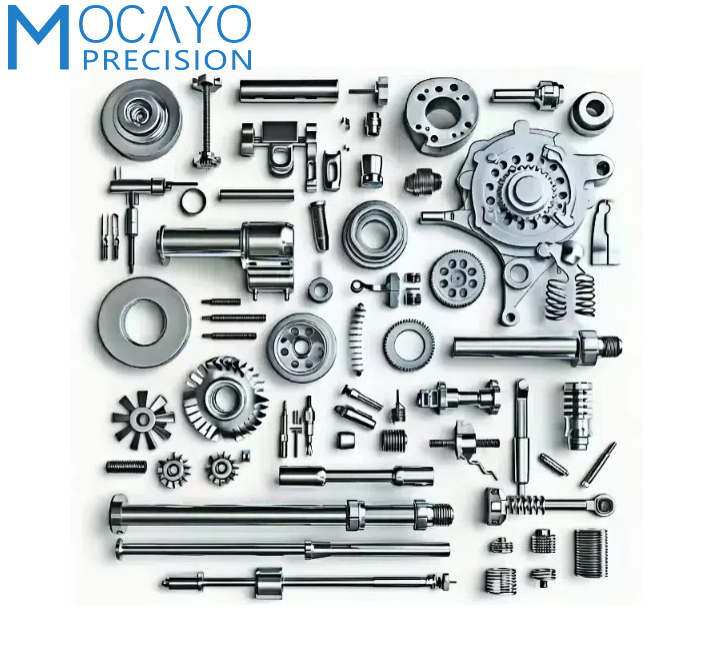
Surface treatment options include:
-
Anodizing (thickness options from 5–25μm)
-
Conductive oxidation (surface resistance <0.1Ω/cm²)
-
Sandblasting (adjustable from 80–240 grit)
For applications demanding magnetic functionality, Mocayo offers proprietary techniques:
-
Selective Electroplating: Nickel-plating only the required areas, preserving non-magnetic zones.
-
Composite Structural Machining: Embedding stainless steel components within the CNC Aluminum Part using precision alignment.
-
Modular Magnetic Design: Standardized interfaces that simplify integration of magnetic functions.
Design Recommendations for Magnetic and Non-Magnetic Aluminum Parts
When selecting a CNC Aluminum Part, it's essential to balance functional demands with machining feasibility. For fully non-magnetic applications, we recommend 5052 or 6061 alloys, which offer optimal mechanical properties alongside superior diamagnetic behavior.
If partial magnetic functionality is required, follow these design principles:
-
Magnetic zones should be ≥3mm thick for mechanical integrity.
-
A transition gap of at least 0.5mm between plated and non-plated areas.
-
Avoid placing magnetic elements in load-bearing zones.
During production, Mocayo maintains rigorous contamination controls:
-
Dedicated non-ferrous cutting tools to avoid iron contamination.
-
Final rinse with deionized water to eliminate magnetic particle residue.
-
Gauss meter inspection ensuring non-magnetic parts measure under 5Gs.
Our engineering team provides full-cycle technical support — from material selection to structural design — to help you achieve optimal performance. Contact a Mocayo sales engineer today for your customized CNC Aluminum Part solution!
How Do You Anodise Aluminium-Mocayo Custom Aluminum Milling
What Are Ball Plungers
Related Article