How Do You Anodise Aluminium-Mocayo Custom Aluminum Milling
How Do You Anodise Aluminium-Mocayo Custom Aluminum Milling
Fundamentals of Aluminium Anodising
How do you anodise aluminium effectively to enhance its surface performance? Anodising is a key electrochemical process that forms a dense oxide layer on aluminium surfaces. The aluminium part acts as the anode in an acidic electrolyte—typically sulfuric acid—under controlled current flow. This treatment yields a durable, corrosion-resistant, and aesthetically pleasing finish. Wondering how do you anodise aluminium? Trust Mocayo’s custom aluminum milling service to deliver premium surface finish and structural integrity.

At Mocayo, we follow advanced processes compliant with ASTM B580 to deliver high-quality results. Our custom aluminum milling service integrates seamlessly with three mainstream anodising solutions:
-
Sulfuric Acid Anodising: The most widely used method, producing oxide layers between 5–25μm thick. It is ideal for electronic housings, automotive components, and more.
Critical Process Controls in Anodising
Achieving optimal anodising outcomes depends on precise process control. At Mocayo, our production system is built on three critical phases:
1. Pre-treatment:
We implement a three-step cleaning routine—alkaline degreasing, acid activation, and deionized water rinsing—to ensure zero surface contamination. Based on application needs, we offer:
-
Mechanical polishing (Ra 0.4–0.8μm)
-
Sandblasting (80–240 mesh)
These methods create a uniform base for the anodising layer.
2. Process Parameters:
Key parameters are stringently monitored:
-
Electrolyte concentration: Sulfuric acid maintained at 18±1%
-
Temperature control: Plate-type heat exchanger ensures 20±1°C
-
Current density: Optimized at 1.5A/dm² using pulse power supply
Mocayo’s consistency in these factors guarantees outstanding anodised finishes for every custom aluminum milling part.
Mocayo Custom Aluminum Milling Solutions
As a fully integrated precision machining provider, Mocayo offers end-to-end solutions from raw material selection to surface treatment. Our CNC facilities house 20 five-axis machining centers capable of:
-
Complex geometry milling: Thin walls down to 0.5mm with minimal distortion
-
Ultra-precision cutting: Positional accuracy of ±0.02mm/300mm
-
Anodising-prepped machining: Stress-avoiding toolpath programming
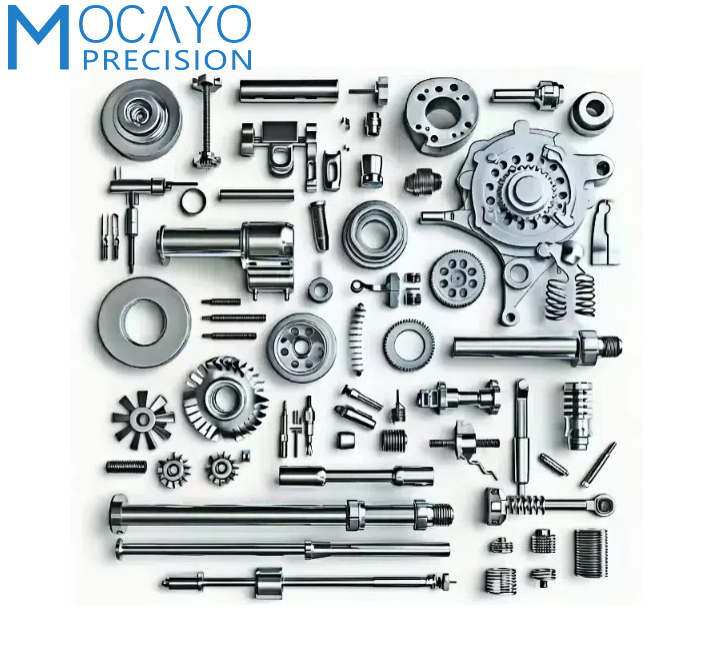
To meet anodising needs, we’ve developed a proprietary pre-treatment package including:
-
Optimized cutting for Ra <1.6
-
Corner rounding to R ≥0.3mm
-
Clamp point planning to avoid key surfaces
Our anodising workshop operates 12 automated lines, capable of processing over 5,000 aluminum parts daily. Film thickness is controlled within ±2μm. For specialized applications such as medical devices, we offer ISO 10993-compliant biocompatible anodising.
Design Expertise and Quality Assurance
For best results in custom aluminum milling and anodising, Mocayo’s engineering team offers design-phase consultation. We recommend:
-
Dimensional Compensation: Allow 0.02mm per side for anodised layer
-
Structural Considerations: Avoid narrow, deep grooves (depth:width ≤ 3:1)
-
Material Selection: Use 6061 for standard anodising; 7075 may require special treatment
Our quality system includes:
-
Full-process inspection:
-
Post-machining 3D CMM checks
-
Pre-anodising surface energy testing (dyne pen)
-
100% film thickness testing (eddy current thickness gauge)
-
-
Certification Compliance:
-
MIL-A-8625F for military-grade finishes
-
AMS 2469 for automotive anodising
-
ISO 13485 for medical-grade production
-
How do you anodise aluminium to meet demanding performance standards? Trust Mocayo’s custom aluminum milling services for fully integrated, high-precision, and scalable solutions. Contact our engineering team today to explore customized anodising options tailored to your industry.
Metric Thread Chart-Mocayo Indexing Plunger
Do Magnets Stick on Aluminum-Mocayo Cnc Aluminum Part
Related Article