


Ball Transfer Units
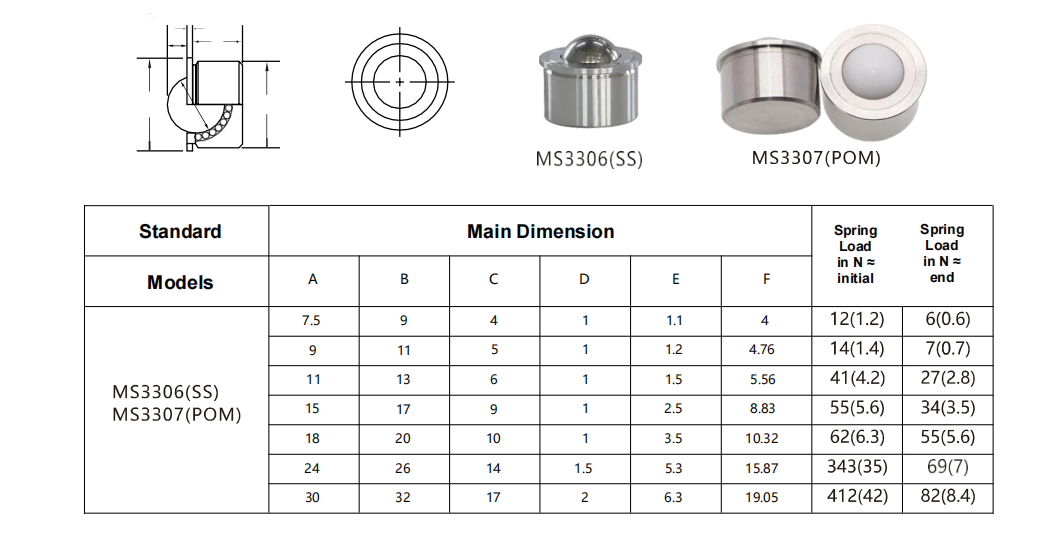
MS3306/7
Ball Transfer Units, also known as ball conveyors or ball supports, are mechanical components used for industrial conveying and positioning, commonly employed to enable multi-directional movement of objects.
Ball Transfer Units are support components that enable free movement in multiple directions, improving handling and positioning efficiency. They are widely used in various industrial automation and logistics systems and are ideal auxiliary components for material handling.
Structural Components:
A Ball Transfer Unit typically consists of the following components:
Main Ball (Large Ball Bearing): Typically made of steel or stainless steel, it is used for direct contact and support of the object.
Supporting small balls: Multiple small steel balls support the main ball, enabling smooth rotation and rolling.
Housing/base: Used to secure the unit to equipment or a work surface, typically made of steel, stainless steel, or plastic.
Seal rings and dust covers: Prevent dust and moisture from entering, extending the unit's service life.
Common materials:
Main ball: carbon steel, stainless steel, nylon;
Seat body: galvanized carbon steel, stainless steel(3306), plastic(3307).
Key Features:
Enables 360-degree free rolling in all directions;
Reduces friction during object movement, turning, and positioning;
High load-bearing capacity, widely applicable for handling heavy objects or large products;
Flexible installation, supporting embedded, bolted, flanged, and other installation methods.
Application Scenarios:
Conveyor lines/assembly lines: Used for cargo turning, diversion, and buffering;
Logistics systems: Such as airport luggage conveyance and parcel sorting systems;
Machine processing positioning platforms: Facilitates precise movement and alignment of workpieces;
Warehousing and loading/unloading: Manual pushing and rapid positioning of heavy objects.
Ball Transfer Units are support components that enable free movement in multiple directions, improving handling and positioning efficiency. They are widely used in various industrial automation and logistics systems and are ideal auxiliary components for material handling.
Structural Components:
A Ball Transfer Unit typically consists of the following components:
Main Ball (Large Ball Bearing): Typically made of steel or stainless steel, it is used for direct contact and support of the object.
Supporting small balls: Multiple small steel balls support the main ball, enabling smooth rotation and rolling.
Housing/base: Used to secure the unit to equipment or a work surface, typically made of steel, stainless steel, or plastic.
Seal rings and dust covers: Prevent dust and moisture from entering, extending the unit's service life.
Common materials:
Main ball: carbon steel, stainless steel, nylon;
Seat body: galvanized carbon steel, stainless steel(3306), plastic(3307).
Key Features:
Enables 360-degree free rolling in all directions;
Reduces friction during object movement, turning, and positioning;
High load-bearing capacity, widely applicable for handling heavy objects or large products;
Flexible installation, supporting embedded, bolted, flanged, and other installation methods.
Application Scenarios:
Conveyor lines/assembly lines: Used for cargo turning, diversion, and buffering;
Logistics systems: Such as airport luggage conveyance and parcel sorting systems;
Machine processing positioning platforms: Facilitates precise movement and alignment of workpieces;
Warehousing and loading/unloading: Manual pushing and rapid positioning of heavy objects.
Quantity:
[Body]AISI3 304.
[Adjustment Ring] AISI3 304.
[Sub-Balls]MS3306:SUS440C (Hardness 55HRC or above).
MS3307:Polyacetal ball. (POM)
[Ball]AISI3 440C (Hardness 55HRC or above).
[Application]Balls are used upwards.
Install ball transfer units quickly on any surface with flexible mounting options—save time and boost productivity instantly.




Recommend Products


